

LEGAL FRAMEWORK & VICTIMS' RIGHTS
Your Rights Matter
You have rights. You are protected. You are not alone.
Violence is not only a private or personal matter. It may constitute a criminal offence and a violation of fundamental human rights. Greek law, together with European Union and international law, establishes a framework for the prevention of violence, protection and support of victims, prosecution of offenders and access to justice.

WHAT HAPPENS WHEN YOU REPORT VIOLENCE?
UNDERSTANDING YOUR LEGAL PROTECTION
The Legal Framework Protecting Victims
Greek legislation, European Union law and international conventions establish complementary protections for victims of violence. Together, they address prevention, criminal accountability, victims’ rights, access to support services and protection from further harm.
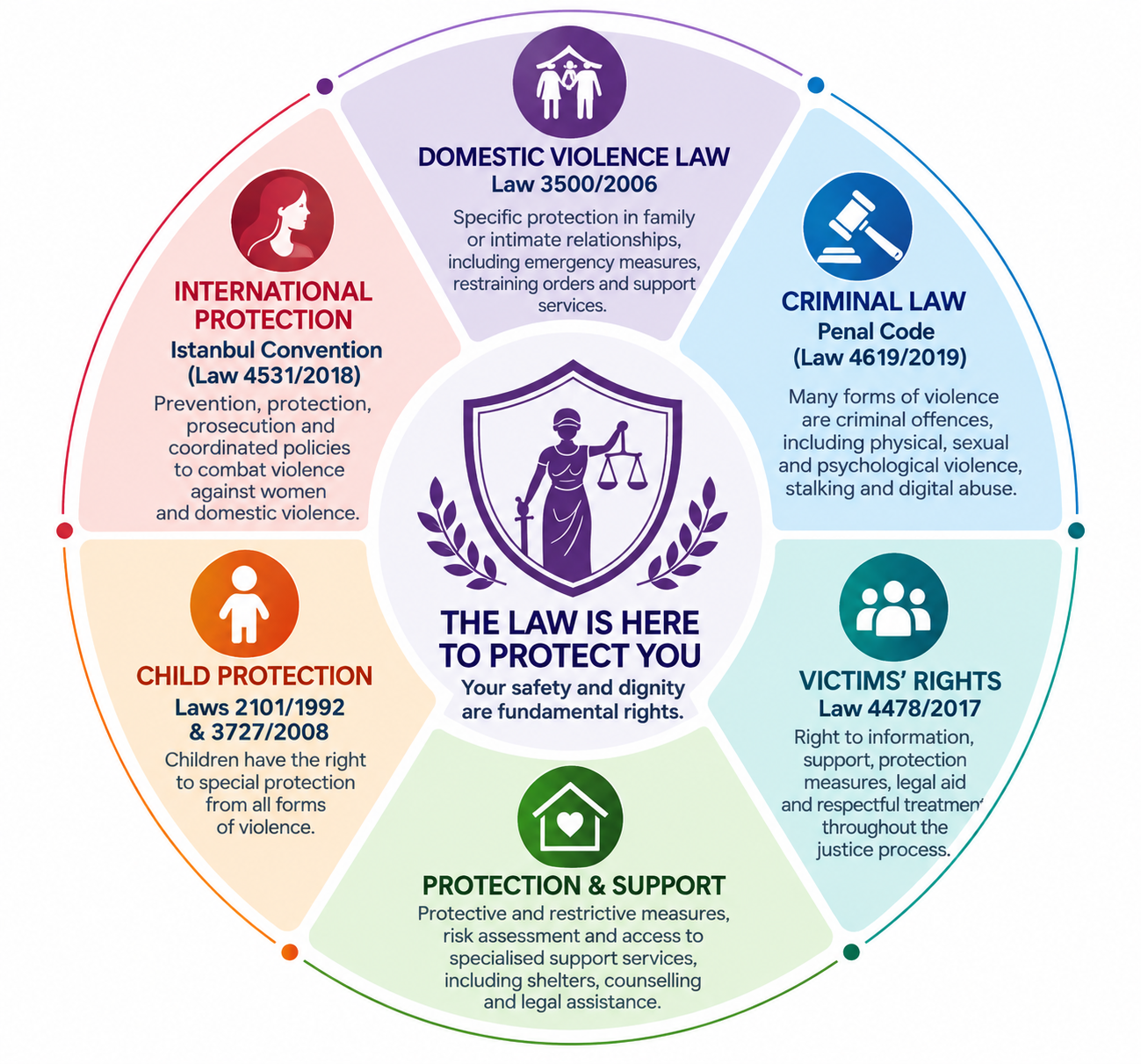
Key Rights for Victims
If you are experiencing domestic or intimate partner violence, you have important rights, including:
The Laws in Detail
Click on each section to learn more about the key laws that protect you from violence in Greece and internationally.
Law 3500/2006 on Combating Domestic Violence
The principal specialised legislation on domestic violence in Greece is Law 3500/2006, as subsequently amended. It establishes a legal framework for addressing violence within family and other relationships covered by the law, including criminal offences, victim protection and criminal proceedings.
What does the law cover?
The legislation addresses domestic bodily harm, threats and coercion, sexual violence within the family, protection of minors and procedural safeguards for victims.
Domestic-violence offences falling within the relevant statutory provisions are prosecuted ex officio, meaning that criminal prosecution does not necessarily depend on a formal complaint by the victim.
The law also provides for protective measures and, under specific legal conditions, criminal mediation. Criminal mediation is not available for every domestic-violence offence.
Important: Law 3500/2006 has been amended several times. Its provisions must be understood in conjunction with subsequent legislation and the Greek Penal Code.
Official legislation: Law 3500/2006 — Hellenic Parliament ↗
Government Gazette A΄ 232/24.10.2006
The Greek Penal Code — Law 4619/2019
Many forms of violence constitute criminal offences under the Greek Penal Code (Law 4619/2019), as subsequently amended. The Penal Code provides the general criminal-law framework for prosecuting acts of violence, including offences that occur outside domestic or family relationships.
What forms of violence are covered?
Depending on the circumstances of a case, relevant criminal offences may include homicide and attempted homicide, bodily harm, threats, coercion, unlawful deprivation of liberty, rape and other forms of sexual violence, offences against minors, trafficking, stalking-related conduct and image-based sexual abuse.
Important: A behaviour does not have to constitute a specific offence under the Domestic Violence Law to be punishable under Greek criminal law. Depending on the facts, provisions of the Penal Code and Law 3500/2006 may operate together.
Official legislation: Law 4619/2019 — Hellenic Parliament ↗
Government Gazette A΄ 95/11.06.2019
Code of Criminal Procedure — Law 4620/2019
The Code of Criminal Procedure (Law 4620/2019), as subsequently amended, regulates the investigation and prosecution of criminal offences and the procedures followed before Greek criminal courts.
Why is criminal procedure important for victims?
The Code governs matters including criminal investigations, evidence, participation in criminal proceedings, procedural safeguards and criminal trials.
It operates alongside specialised domestic-violence legislation and victims' rights legislation. Together, these provisions help determine how a reported offence is investigated, how proceedings develop and what protections may be available to victims.
Important: The procedures and safeguards applicable to an individual case depend on the nature of the alleged offence, the circumstances and the legislation currently in force.
Official legislation: Law 4620/2019 — Hellenic Parliament ↗
Government Gazette A΄ 96/11.06.2019
Law 4478/2017 — Rights of Victims of Crime
Law 4478/2017 incorporated into Greek law the European Union framework establishing minimum standards on the rights, support and protection of victims of crime, particularly Directive 2012/29/EU.
Under this framework, victims are not simply witnesses to a criminal offence. They are rights-holders entitled to information, support and protection throughout the relevant stages of criminal proceedings.
What rights do victims have?
Depending on the circumstances and applicable legal provisions, victims have rights concerning:
- Receiving clear and accessible information about their rights and available services.
- Understanding and being understood when communicating with competent authorities.
- Accessing victim-support services.
- Interpretation and translation where legally required.
- Receiving information about the progress of criminal proceedings.
- Participating in criminal proceedings in accordance with applicable law.
- Protection of privacy, dignity and personal information.
- Protection against intimidation, retaliation, repeat victimisation and secondary victimisation.
- Individual assessment of protection needs.
- Additional safeguards for children and victims with specific protection needs.
Why is this legislation important?
The legislation recognises that victims may face significant barriers when seeking help or participating in criminal proceedings. These barriers may be particularly relevant for children, persons with disabilities, migrants and people who do not speak Greek.
Important: Specific rights and procedural safeguards depend on the circumstances of the case and the applicable legislation. Victims can seek information and support without first having to determine the legal classification of the offence.
Official legislation: Law 4478/2017 — Ministry of Justice (Official Gazette PDF) ↗
Government Gazette A΄ 91/23.06.2017
Sexual Violence and Sexual Autonomy
Sexual violence is a serious violation of a person's sexual autonomy and may constitute a criminal offence under the Greek Penal Code (Law 4619/2019), as subsequently amended.
Greek criminal legislation addresses rape, other violations of sexual freedom, sexual acts involving children, sexual exploitation and other forms of sexual abuse.
Sexual violence may occur within or outside an intimate relationship or family. Marriage, partnership or a previous sexual relationship does not remove a person's right to sexual autonomy.
Victims do not need to determine the precise legal classification of what happened before seeking information, protection or support.
Stalking, Digital Violence and Technology-Facilitated Abuse
Violence can occur through digital technologies as well as through face-to-face behaviour. Technology may be used to threaten, intimidate, monitor, harass or control another person.
What behaviours may be involved?
- Persistent unwanted communication and stalking.
- Threats, intimidation and digital harassment.
- Unauthorised monitoring or surveillance.
- Non-consensual sharing of intimate images or material.
- Misuse of personal information to intimidate or control someone.
- Other forms of technology-facilitated sexual or psychological abuse.
Depending on the conduct and circumstances, relevant provisions may be found in the Greek Penal Code, Law 3500/2006 and Law 5172/2025.
Law 5172/2025 — Strengthening Legal Protection
Law 5172/2025 introduced reforms addressing new forms of violence against women, incorporating provisions connected with Directive (EU) 2024/1385 and strengthening the domestic-violence framework.
The legislation recognises the importance of responding to contemporary forms of abuse, including certain forms of violence facilitated by information and communication technologies.
Important: Digital abuse may form part of a wider pattern of coercive control, particularly when technology is used to monitor, isolate, threaten or intimidate a victim. Whether particular conduct constitutes a criminal offence depends on the applicable legal provisions and the circumstances.
Official Legislation
Greek Penal Code: Law 4619/2019 — Hellenic Parliament ↗
Government Gazette A΄ 95/11.06.2019
Protection against new forms of violence: Law 5172/2025 — Hellenic Parliament ↗
Government Gazette A΄ 10/29.01.2025
Protection of Children from Violence
Children have the right to special protection from all forms of violence, abuse, exploitation and neglect. Greek child-protection legislation operates through several interconnected legal instruments, including the Domestic Violence Law, the Penal Code and international conventions ratified by Greece.
Law 2101/1992 — UN Convention on the Rights of the Child
Through Law 2101/1992, Greece ratified the United Nations Convention on the Rights of the Child, establishing fundamental principles for protecting children's rights.
The Convention recognises every child's right to protection from physical and psychological violence, abuse, neglect, maltreatment and exploitation.
It also emphasises the best interests of the child, non-discrimination and children's right to express their views in matters affecting them, in accordance with their age and maturity.
Official source: UN Convention on the Rights of the Child — Hellenic Parliament (PDF) ↗
Law 2101/1992 — Government Gazette A΄ 192/02.12.1992
Law 3727/2008 — Lanzarote Convention
Law 3727/2008 ratified the Council of Europe Convention on the Protection of Children against Sexual Exploitation and Sexual Abuse, known as the Lanzarote Convention.
The Convention establishes obligations concerning the prevention of child sexual exploitation and abuse, protection and assistance for child victims, prosecution of offences and cooperation between relevant authorities.
It recognises the importance of child-sensitive procedures, professional training and measures designed to reduce the risk of further harm to children.
Official source: Law 3727/2008 — Hellenic Parliament Legislative Search ↗
Government Gazette A΄ 257/18.12.2008
Children and Domestic Violence
Children should not be regarded solely as secondary or indirect parties to domestic violence. A child may be directly subjected to physical, psychological or sexual violence, while exposure to violence within the family also raises serious safeguarding concerns.
Depending on the circumstances, the Domestic Violence Law, Penal Code and Code of Criminal Procedure provide relevant criminal-law protections and procedural safeguards.
Important: Children who experience or are exposed to violence may require specialised protection, age-appropriate support and coordinated intervention by competent services and authorities.
Law 4808/2021 — Violence and Harassment at Work
Law 4808/2021 establishes an important legal framework for preventing and addressing violence and harassment in the world of work. It also ratifies the International Labour Organization's Convention No. 190 on Violence and Harassment.
The legislation recognises that violence and harassment can undermine workers' dignity, safety, health and equal participation in professional life.
What protections does the law provide?
The legislation addresses violence and harassment connected with work, including conduct that may cause physical, psychological, sexual or economic harm.
- Prevention of violence and harassment in work-related settings.
- Employer obligations concerning prevention and appropriate responses.
- Procedures for reporting and examining complaints.
- Protection against retaliation for exercising relevant legal rights.
- Access to competent authorities and applicable remedies.
Depending on the circumstances, protections may extend beyond the traditional workplace to other situations connected with work, including certain work-related communications and activities.
Official legislation: Law 4808/2021 — National Printing Office, Government Gazette ↗
Government Gazette A΄ 101/19.06.2021
Law 3896/2010 — Equal Treatment in Employment
Law 3896/2010 establishes protections concerning equal opportunities and equal treatment of women and men in employment and occupation, incorporating the relevant European Union equality framework into Greek legislation.
The law addresses sex-based discrimination, including harassment and sexual harassment, in the context of employment and professional life.
Why is this legislation important?
Sexual harassment and harassment related to sex are not simply workplace disagreements. They may constitute unlawful discrimination and violations of a person's dignity and rights.
The legislation provides a framework for equal treatment, legal protection and access to relevant complaint and enforcement mechanisms.
Official legislation: Law 3896/2010 — Hellenic Parliament ↗
Government Gazette A΄ 207/08.12.2010
Seeking Support
People experiencing violence or harassment at work may seek information about their rights, available reporting procedures and appropriate support services.
Important: The applicable procedures and remedies depend on the circumstances and the legislation currently in force.
The Istanbul Convention — Law 4531/2018
Greece ratified the Council of Europe Convention on Preventing and Combating Violence against Women and Domestic Violence, commonly known as the Istanbul Convention, through Law 4531/2018.
The Convention recognises violence against women as both a human-rights violation and a form of discrimination against women. It establishes a comprehensive framework for preventing violence, protecting victims, prosecuting offenders and coordinating public policies.
The Four Pillars of the Convention
- Prevention: Addressing the causes of violence through education, awareness-raising and professional training.
- Protection: Ensuring victims can access appropriate support, safety measures and specialist services.
- Prosecution: Strengthening legal responses to violence and accountability for offenders.
- Integrated Policies: Promoting coordinated action between public authorities, specialist services and civil society organisations.
The Convention addresses physical, sexual, psychological and economic violence, including domestic violence, stalking, forced marriage and other forms of gender-based violence.
Perpetrator Intervention Programmes — Article 16
Article 16 requires measures to establish or support preventive intervention and treatment programmes for perpetrators of domestic violence and sexual offenders.
These programmes must be developed with particular attention to the safety, support and human rights of victims and, where appropriate, in close coordination with specialist victim-support services.
This provision is particularly relevant to VIASTOP's work in supporting victims and implementing specialised perpetrator intervention programmes.
Official Greek legislation: Law 4531/2018 — Hellenic Parliament Legislative Search ↗
Government Gazette A΄ 62/05.04.2018
European Union Framework — Directive (EU) 2024/1385
Directive (EU) 2024/1385 on combating violence against women and domestic violence strengthens the European Union's common legal framework for prevention, victim protection, access to justice and coordinated responses to violence.
The Directive addresses specific forms of violence, including certain forms of cyber violence, and establishes minimum requirements concerning victim support, individual risk assessment, prevention and cooperation between competent authorities.
It complements existing European legislation on victims' rights and the international obligations established by the Istanbul Convention.
Important: An EU directive requires implementation through national law. Its provisions should therefore be considered together with the applicable Greek legislation and relevant implementation deadlines.
Official EU legislation: Directive (EU) 2024/1385 — EUR-Lex, Official Journal of the European Union ↗
Official Journal of the European Union, 24.05.2024
Law 5090/2024 — Modernising Domestic Violence Legislation
Law 5090/2024 introduced significant amendments to the Greek Penal Code, Code of Criminal Procedure and domestic-violence legislation.
The reforms included a dedicated chapter concerning the modernisation of the legal framework for preventing and combating domestic violence, including amendments affecting Law 3500/2006.
Why are these reforms important?
The legislation revised aspects of the domestic-violence framework, including provisions concerning criminal mediation and victim protection. These amendments form part of the evolving legal response to domestic violence in Greece.
Important: Law 3500/2006 must be read together with subsequent amendments, rather than relying exclusively on its original provisions.
Official legislation: Law 5090/2024 — Hellenic Parliament ↗
Government Gazette A΄ 30/23.02.2024
Law 5172/2025 — Addressing New Forms of Violence Against Women
Law 5172/2025 introduced further measures addressing violence against women and domestic violence, including provisions connected with Directive (EU) 2024/1385 and additional amendments to domestic-violence legislation.
The reforms address contemporary forms of abuse, including certain forms facilitated through information and communication technologies.
Violence Beyond Physical Spaces
Violence may continue through digital technologies and other forms of unwanted contact. Depending on the circumstances, abusive behaviour may involve:
- Threats, intimidation and harassment.
- Persistent unwanted communication and stalking.
- Technology-facilitated monitoring and surveillance.
- Non-consensual dissemination of intimate material.
- Other behaviours forming part of a wider pattern of coercive control.
Whether particular conduct constitutes a criminal offence depends on the relevant legal provisions and the facts of the individual case.
Strengthening Victim Protection
These legislative developments reinforce the importance of effective victim protection, appropriate criminal-law responses and coordination between competent authorities and support services.
Important: The legal framework continues to evolve. Victims should be provided with information based on the legislation currently in force and the circumstances of their case.
Official legislation: Law 5172/2025 — Hellenic Parliament ↗
Government Gazette A΄ 10/29.01.2025
Violence against women cannot be separated from the wider issue of gender inequality.
Law 4604/2019 on the Promotion of Substantive Gender Equality and the Prevention and Combating of Gender-Based Violence established an important national framework linking gender equality, public policy, and the prevention of gender-based violence.
This framework recognises that combating violence requires more than responding after an offence has occurred. It also requires:
- Prevention of gender-based violence
- Gender equality policies
- Institutional coordination
- Education and awareness-raising
- Action against structural inequalities that enable gender-based violence
The legislation reflects the importance of addressing the underlying social and institutional conditions that contribute to gender inequality and violence, alongside legal protection and support for victims.
Legal reference: Law 4604/2019 — Promotion of Substantive Gender Equality and Prevention and Combating of Gender-Based Violence.
Previous Page
The Cycle of Violence
Next Page
The Impact of Violence